Technology · Audacity · Consciousness

Pursue a goal that feels impossible right now.

The system around you rewards the safe, incremental move. This is a coach for the other kind: the bold leap that changes the game instead of grinding harder at it, made at the pace your readiness allows.

Free to start/One question to begin

The goals that matter most ask for a bold leap. The system you work inside rewards something else: the familiar move, the incremental step, the thing that shows a return by the next quarter. So the boldest ideas get talked down before they are ever tested, and the people carrying them quietly learn to aim lower.

This is the work of going the other way. Cultivating audacity, in yourself and in the people around you. Protecting an idea while it is still forming, before it has to make sense to anyone else. And knowing the difference between the moment that asks for patience and the moment that asks for the leap.

Stepping outside the system is not breaking the rules. It's noticing rules that aren't really rules.

Why this, why now

AI is doubling every few months. Biology has become writable. Geopolitics is reshuffling and the climate is meeting hard limits. The outer world is bending exponentially while our institutions, our habits, and our inner operating systems stay calibrated for a linear one.

The world is moving faster, and it is calling us forward.

Three forces, one intersection.

The moment asks for work at the meeting point of three things most efforts keep apart. Each is powerful on its own. Together, they compound.

01 / Technology

Exponential tools

AI now moves faster than the institutions and habits built to use it. We build with that speed, in service of who you are becoming.

02 / Audacity

Impossible as a direction

We treat impossible as a direction to walk toward rather than a verdict to accept. The goal that does not fit inside who you are today is the one worth choosing.

03 / Consciousness

The inner upgrade

The hardest changes are inner ones: how you see, what you believe, who you are while you act. This is the slow, real work of adult development.

We build at the point where all three meet, and this coach is our first attempt at it. We think it's powerful, and we want to share it.

The method

Change the game, don't grind harder.

First-order

Optimizing the system you have

Doing more, better, or harder inside your current way of operating. It produces incremental results at best, and against a goal that feels impossible, often nothing at all.

Second-order

Changing the system itself

Stepping outside the way things are currently done and changing what produces your results. Harder and less comfortable, and the only thing that actually moves an impossible goal.

01

Set the impossible goal

Name the goal that is genuinely yours, not the one assigned to you or the one that is safe to admit. Specific enough to create real tension, large enough that reaching it requires you to change, not just to do more.

02

Map the transformation

Define what has to become true, across your mindset, your habits, the systems around you, and the people you lead, before the goal is possible. The map is also your direction of travel: it names where you are heading even when the exact route is unknown, and each shift you make possible brings the next one within reach. That compounding is how a goal that looks impossible turns into one you can actually walk toward.

03

Run bold experiments

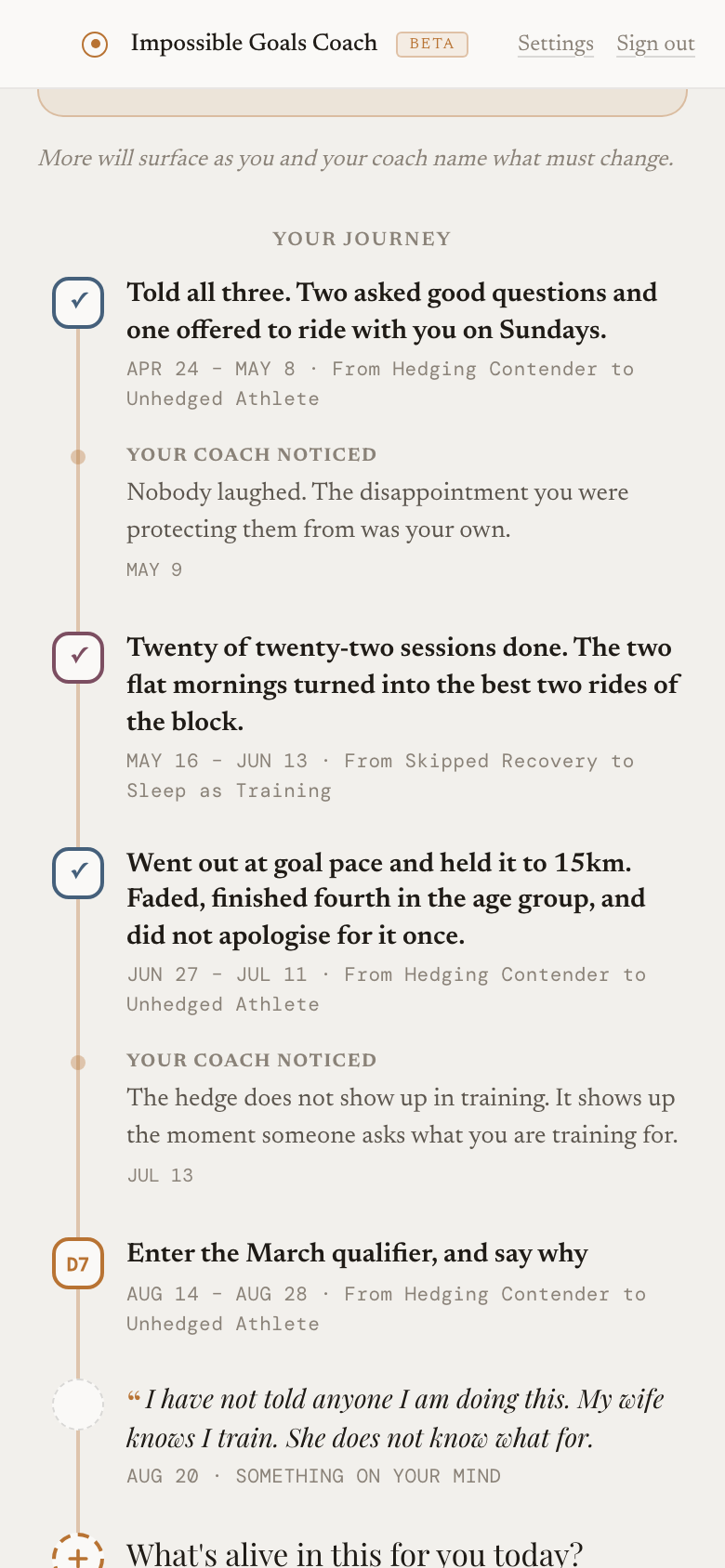
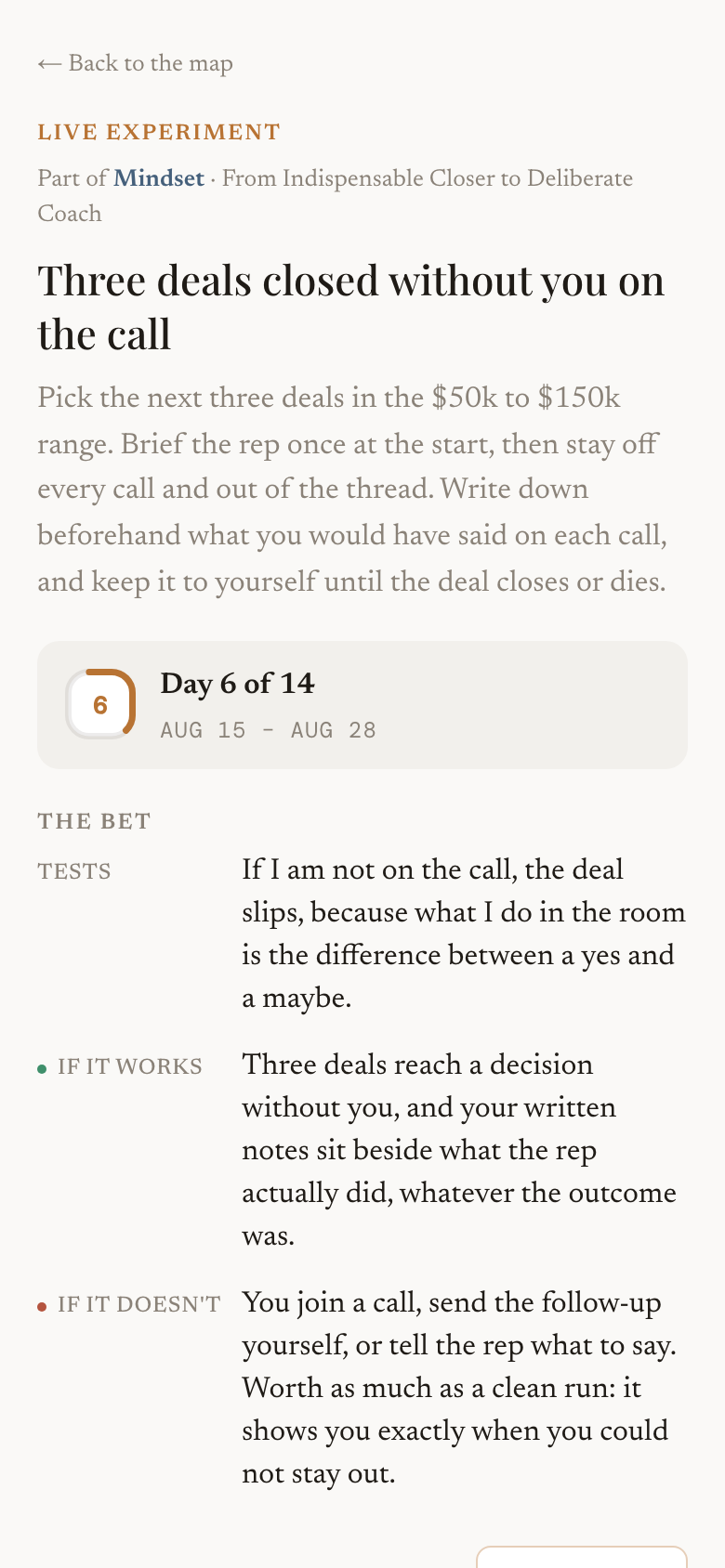
Run experiments that step outside the system instead of grinding harder inside it. Emotionally bold and strategically safe: reversible probes that feel daring but cannot break anything, run at the pace your readiness allows. Each one finds the next real step on the route, and shifts you, your team, and the system around you closer to the goal.

What the coach is built on

A method with a lineage.

Habit trackers, reminders, and task lists help you do more of what you already know how to do. The goals that feel impossible are a different kind of problem. They ask you to change how you see, what you believe, and who you become while you pursue them.

That kind of change has been studied for half a century. This coach is built directly on that research. Below is the lineage it draws on.

Phase 01 · The GoalChoosing a goal that demands change
01
Ronald Heifetz
Adaptive Leadership

Some problems yield to what you already know. Others require you to change before they can move at all. The coach checks that your goal is the second kind, because that is the only kind this method is built to serve.

02
Peter Diamandis
10x Thinking

A goal ten times beyond your current reach cannot be met by doing more of what you already do. The coach pushes for that scale, because it is the size of goal that makes genuine change necessary rather than optional.

03
Otto Scharmer
Theory U

Underneath the goal you say out loud, there is often the one you actually want. The coach uses presencing questions, what wants to let go and what wants to emerge, to reach the real goal beneath the safe one.

Phase 02 · The SystemChanging the system that produces your results
04
Paul Watzlawick
Second-Order Change

There is a difference between working harder inside your current system and changing the system itself. Every part of this method works on the second of those, the change that alters what your effort is even capable of producing.

05
The core of the method
Robert Kegan & Lisa Lahey
Immunity to Change

Beneath a change you genuinely want, a quieter commitment is often working to keep you exactly as you are, held in place by a single belief you treat as plain fact. The coach surfaces that belief, holds it up as something testable, and designs small, safe experiments that loosen its grip over time. The same pattern scales to organizations, where shared assumptions hold a culture in place. This is the engine of the whole method.

Phase 03 · The TestTesting your way forward, and what makes change hold
06
Dave Snowden
Cynefin · Safe-to-Fail Probes

In genuinely complex situations, you cannot plan your way to the answer, you probe toward it. Every experiment the coach designs is a safe-to-fail probe: small, reversible, and built to teach you something real whatever the outcome.

07
Jennifer Garvey Berger
Vertical Development

Growing wider means adding skills and information. Growing taller means developing a larger way of seeing the same situation. The coach tracks your progress by the second of those, the shift in how you hold the problem itself.

08
Richard Strozzi-Heckler
Somatic Leadership

Transformation is embodied, practiced into the body over time, not understood once and adopted. The coach treats your experiments as repetitions and respects the tempo real change requires, leaning in when you are ready and waiting when a shift needs time to take hold.

And where it begins

Carol Dweck, Growth Mindset.Most personal-growth tools rest on a single idea: that you are capable of change. Dweck's work made that idea mainstream, and it is the ground this stands on. From there, the coach goes to work on the mechanics, the exact belief holding one specific goal out of reach, and what it takes to move it.

· · ·

You'll never hear these names in a session. The coach speaks in plain language. The theory lives in how it thinks.

Meet the coach

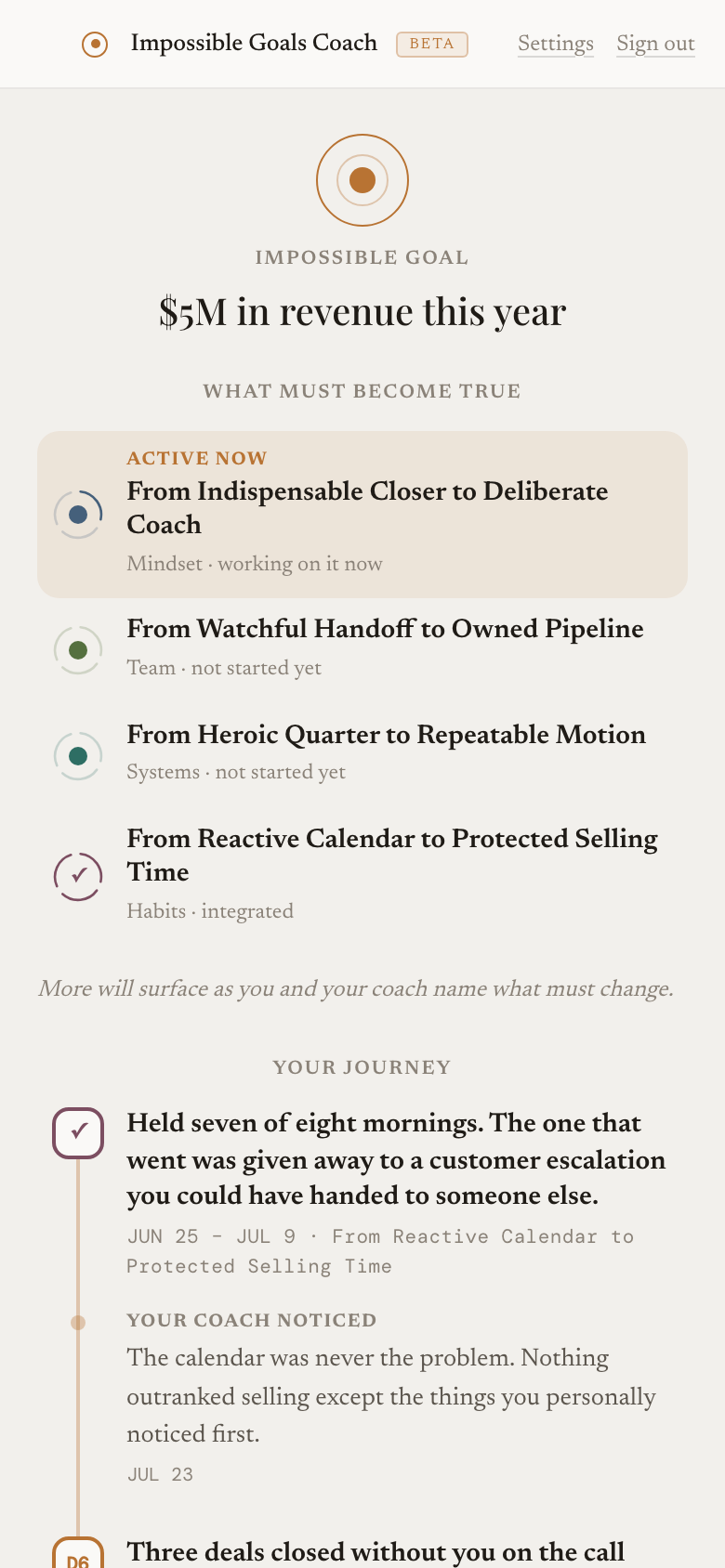
See it think.

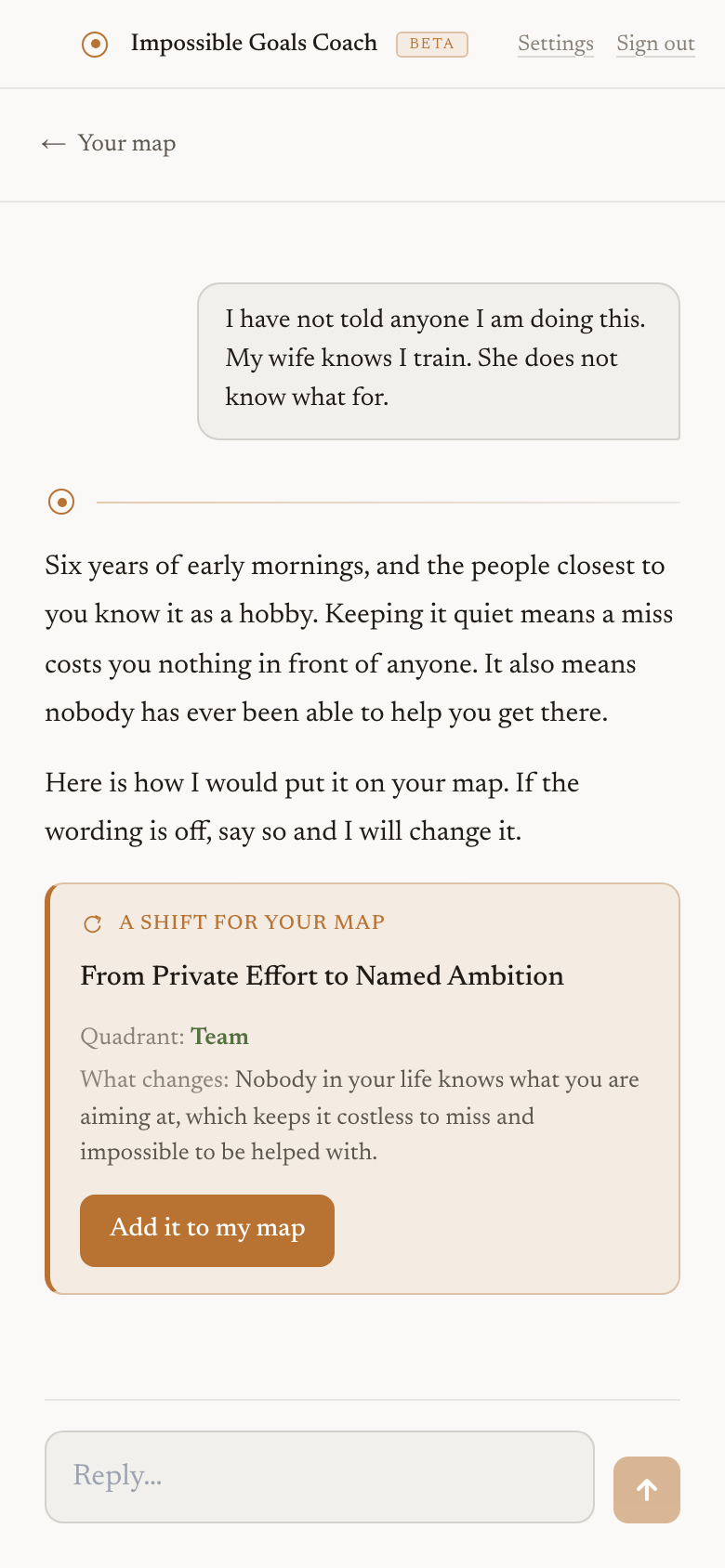
It opens with one question, then helps you find the bold move the system has been talking you out of. Here is the kind of turn that happens in the first few minutes.

The Impossible Goals coach in action
A first conversation
Coach

What's the goal you've been circling, the one that would mean changing how you operate, not just working more hours at how you operate now?

You

I want my team to ship the platform rebuild in six months. Leadership says it takes eighteen. I've been trying to find ways to speed up the current plan.

Coach

Speeding up the current plan is the grind, and the math rarely works that way. Before we touch the plan: where did eighteen months come from?

You

It's just what these projects take here. Every big rebuild has gone that way.

Coach

That's a real pattern, so the number isn't invented. But has anyone actually rebuilt it a different way and still gotten eighteen months, or is that the only way it's ever been tried?

You

Honestly, it's the only way we've tried. Full sequential rebuild, every time.

Coach

Then eighteen months might be a fact about one approach, not a fact about the work.

Coach

Here's a move worth testing, and it will feel exposed. Take the one piece everyone treats as untouchable, and prove a parallel rebuild of just that piece in three weeks. Small enough that if it fails, nothing breaks. Bold enough that a success changes the conversation. Which piece would they say you can't touch?

You

…the payments service. Everyone treats it as off-limits.

Coach

That's the one, because it's where the assumed rule is strongest. One thing before we size it: is this a week where you have the room to run something that might rattle people, or is that better held for a steadier one?

Start your own conversation →Free to start, no experience required
Free to start

Begin at no cost, no card. It grows into a paid product over time, so the early door is the free one.

A conversation

You talk with the coach from the first minute. There is no long form to fill out.

Minutes to a move

You leave the first session with one bold, bounded experiment to run, not a reading list.

Yours alone

Private by default. Not your employer's, not your manager's. Real candor depends on it.

Be among the first

This is new. The coach you can use today is our first build from that intersection. We'd rather share it early than perfect it in private, so the people who start now start as some of the first. We think it's powerful, and we want you in it.

What's the goal you've been avoiding, the one that requires you to become someone different?

That's where we begin.

Start with an impossible goal →

Free to start. Paid as it grows.

Writing

Thinking out loud.

Essay

Impossible Goals as a Developmental Technology

A framework for using the pursuit of impossible goals as the primary mechanism for adult development, grounded in Ken Wilber's Integral Theory and Otto Scharmer's Theory U.

Read the article →

Follow the thinking.

New writing on impossible goals, second-order change, and human development. No frequency promises.

No frequency promises. Unsubscribe anytime.

For coaches, researchers, and builders. If this framework is compelling, read the research, start a local hub, or build what this becomes with us.